Cruciate Ligament Surgery in Wie
, Your Cruciate Ligament Specialist
Minimally invasive cruciate ligament surgery for maximum stability—customized and performed arthroscopically.
An ACL surgery—medically known as anterior cruciate ligament reconstruction—replaces the torn anterior cruciate ligament with a tendon graft taken from the patient’s own body and permanently restores the knee’s stability. The procedure is performed arthroscopically through two skin incisions approximately 5 millimeters in size, takes 40 to 60 minutes, and typically requires only one night in the hospital. Studies show success rates of over 90 percent when the surgery is combined with consistent rehabilitation.
Dr. Gustav Timmel, MD, a specialist in orthopedics and traumatology in 1030 Vienna, specializes in cruciate ligament surgery and selects the surgical method and graft on a case-by-case basis, taking into account the tear pattern, age, leg alignment, and athletic needs.
OVERVIEW
When is cruciate ligament surgery advisable?
Cruciate ligament surgery is always recommended when the knee is unstable or when the patient is involved in high-level sports. A completely torn anterior cruciate ligament does not heal on its own. If left untreated, it can lead to secondary damage to the meniscus and cartilage, and even premature osteoarthritis. However, not every cruciate ligament tear requires surgery.
A clear indication for surgery exists in the following cases:
- Complete cruciate ligament tear— the anterior cruciate ligament does not heal on its own
- Instability in Daily Life —The Knee "Gives Out" (Giving-Way Episodes)
- High levels of physical exertion —especially during changes of direction and jumps (soccer, handball, skiing)
- Young, active patients —to prevent long-term damage and premature joint wear
- Concomitant injuries —meniscus or cartilage damage that can be treated during the same surgery
For older patients who do not participate in sports and do not have detectable instability, conservative treatment involving physical therapy and targeted muscle strengthening may be sufficient. You can read in detail about the criteria for this approach and how conservative treatment is carried out on the page Cruciate Ligament Tear: Symptoms, Diagnosis, and Treatment.
Cruciate ligament suture or cruciate ligament reconstruction?
Cruciate ligament repair (refixation) is only possible if the cruciate ligament has torn directly from the bone, the patient is older than 25, and the surgery takes place within three weeks of the injury. In all other cases—particularly with tears in the middle of the ligament and in young athletes—cruciate ligament reconstruction is the more reliable procedure, because suturing carries a higher risk of failure.
Cruciate Ligament Repair (Cruciate Ligament Suture)
The ligament is reattached to the bone arthroscopically using special suture anchors. Advantage: The body’s own cruciate ligament is preserved, and in some cases, rehabilitation is faster.
Requirements for a cruciate ligament suture:
- Patients over the age of 25
- Surgery within 3 weeks of the injury
- Cruciate ligament torn directly from the bone (not in the middle of the ligament)
Cruciate Ligament Replacement Surgery (Cruciate Ligament Reconstruction)
The torn cruciate ligament is replaced with a tendon graft taken from the patient’s own body. This procedure has been tried and tested for decades and is considered the standard of care for restoring long-term knee stability.
Which transplant is the right one?
Four grafts are available for cruciate ligament reconstruction: the hamstring tendon (semitendinosus), the patellar tendon, the quadriceps tendon, and the donor tendon (allograft). There is no single graft that is best for all patients. The choice depends on bone size, leg alignment, associated injuries, and the patient’s preferred sport—jumping and sprinting place different demands on the knee.
| Transplantat | Entnahme | Vorteil | Zu bedenken | Typisch geeignet für |
|---|---|---|---|---|
| Semitendinosussehne (Hamstring, All-inside) | 2–3 cm Schnitt oberhalb der Kniekehle (posteromedial) | Schonendste Technik: nur eine Sehne nötig, zweite Hamstringsehne bleibt unberührt; sehr starke Primärfixation; Hautnerv wird geschont | Kraft der Kniebeugung kann kurzfristig reduziert sein | Standardverfahren, Ballsportler |
| Patellasehne (BTB – bone tendon bone) | Mittleres Drittel mit je einem Knochenblock aus Kniescheibe und Schienbeinkopf | Knochenblöcke wachsen schneller ein → schnellere Rückkehr zum Sport | Belastungsschmerz beim Knien möglich | Leistungs- und Kontaktsportler |
| Quadrizepssehne | 3–4 cm Schnitt oberhalb der Kniescheibe | Transplantatstärke individuell wählbar; mit oder ohne Knochenblock entnehmbar | Narbe oberhalb der Kniescheibe | Große/kräftige Patienten, Revisionen |
| Allograft (Spendersehne) | keine Entnahme am Patienten | Keine Entnahmestelle, kein zusätzlicher Schnitt | Bei jungen Sportlern etwas höhere Re-Ruptur-Rate | Ältere Patienten, Revisionseingriffe |
The All-Inside Technique in Detail
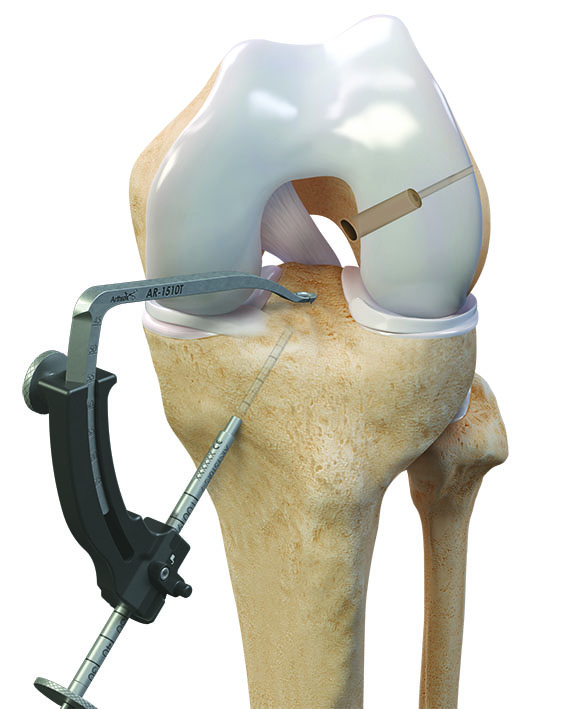
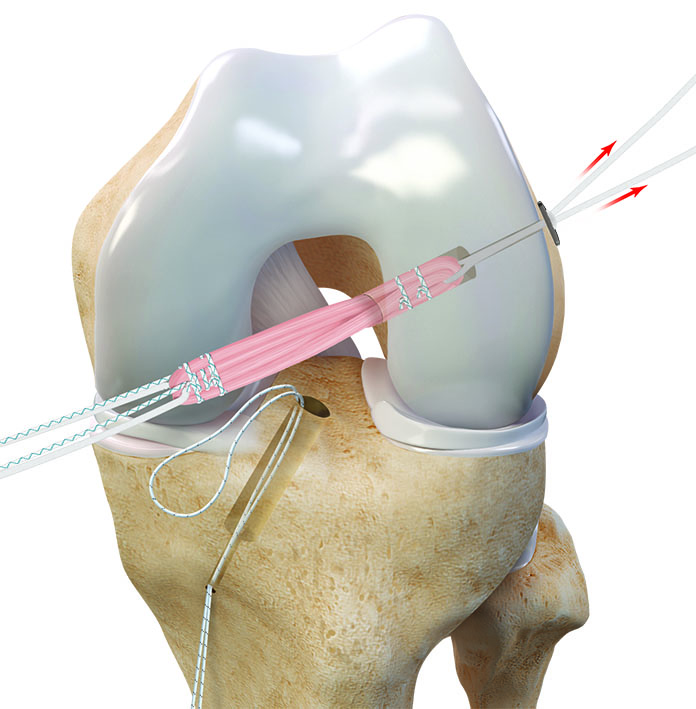
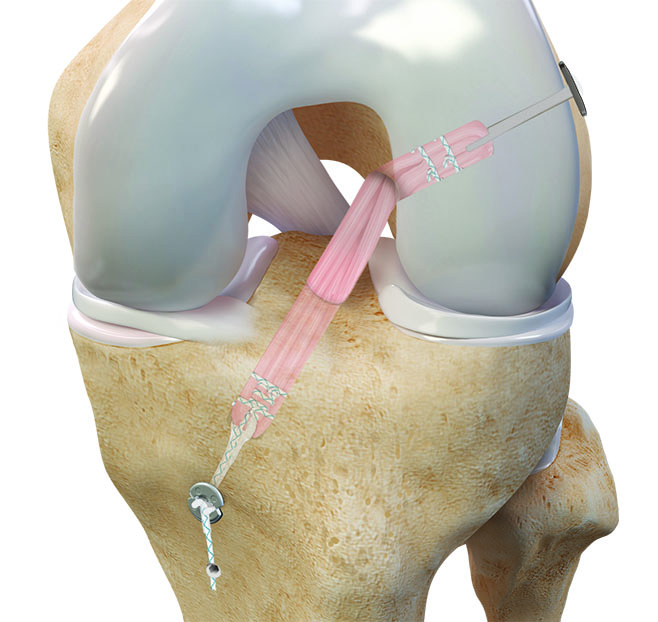
The all-inside technique is one of the least invasive methods of cruciate ligament surgery. The new cruciate ligament is pulled into short, pre-drilled bone tunnels using a pulley technique with two metal plates and then secured in place. Unlike conventional techniques, which require two tendons, the semitendinosus tendon alone is sufficient here.
The tendon is harvested through an incision just 2–3 cm long, made just above the back of the knee. This protects the ramus infrapatellaris—a cutaneous nerve that is injured in up to 10% of cases using conventional methods, leading to numbness on the inner side of the lower leg.
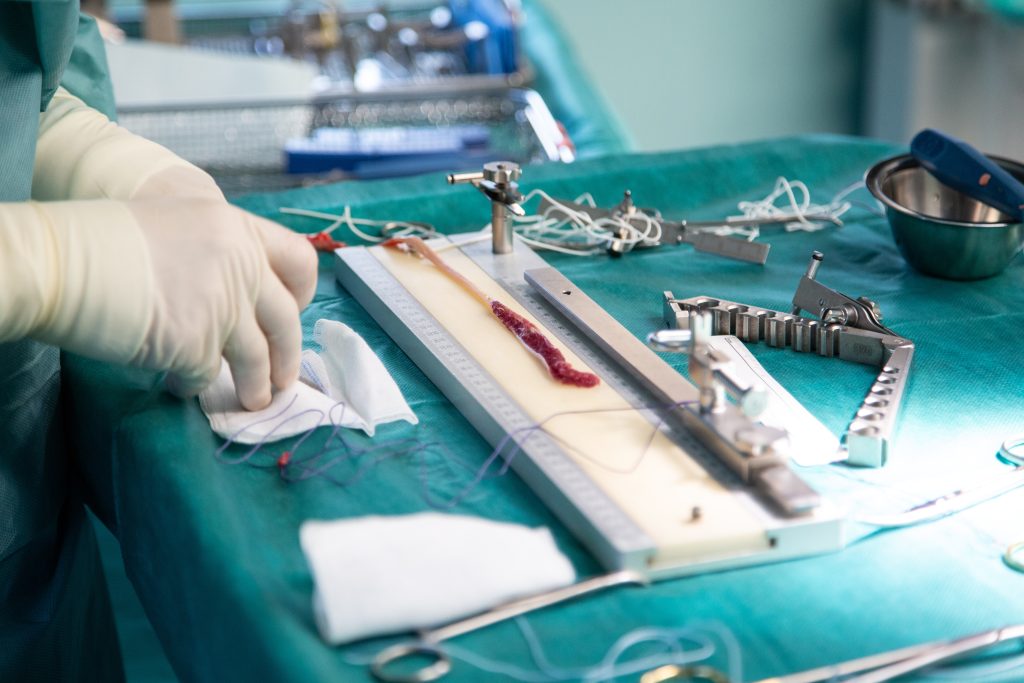
The graft is prepared using two adjustable suture loops (Tightrope) and metal plates and is soaked in an antibiotic solution, which reduces the risk of infection to virtually zero. Next, two bone tunnels are created at the anatomical origin of the cruciate ligament in the femur and the tibial tuberosity. Once the graft is inserted, the metal plates “flip” against the outer surface of the bone, securely anchoring the ligament.
Advantages: anatomical positioning, particularly strong primary fixation, individually selectable graft thickness.
Specialist in cruciate ligament surgery
Find out more about cruciate ligament surgery & treatment for a torn cruciate ligament in this video!
How is a cruciate ligament rupture operated on?
Nowadays, a personalized treatment approach is the norm. For me, it’s no longer enough to use the same cruciate ligament graft for every patient. Factors such as bone size, leg alignment, associated injuries, or the patient’s preferred sport (jumping or sprinting) are all factored into the individualized treatment algorithm.
In many cases, the anterior cruciate ligament does not tear on its own. Associated injuries, such as meniscal tears, capsule tears, or ligament injuries, are common. Therefore , the timing of surgery—as well as any additional procedures intended to increase joint stability — should be carefully considered.
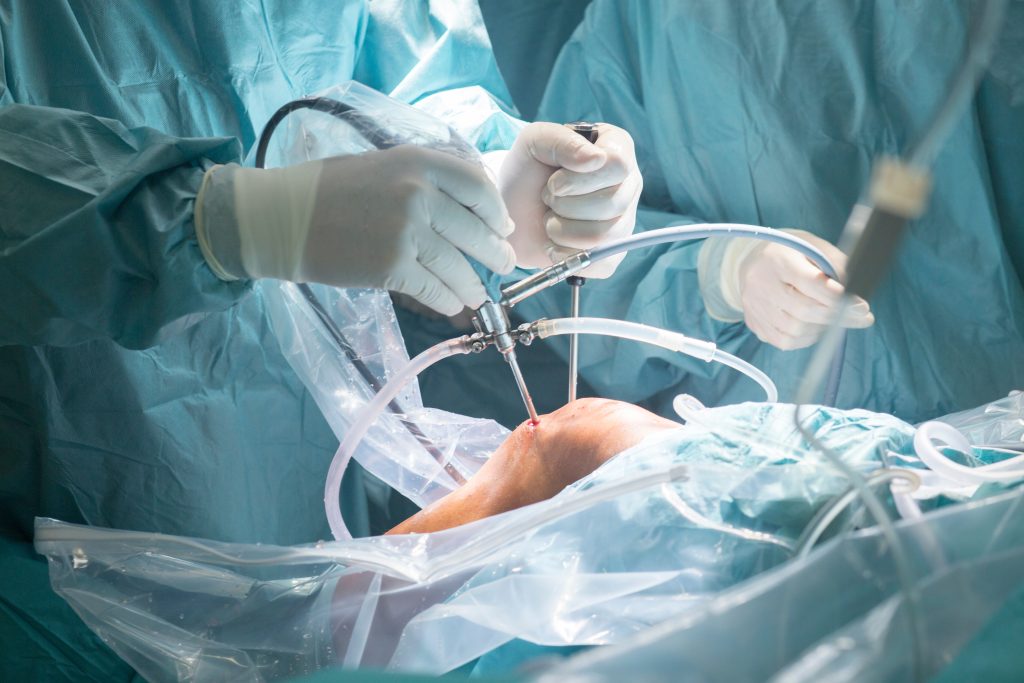
During a diagnostic arthroscopy (= keyhole technique), the entire joint is inspected from the inside with a camera through skin incisions measuring just 2×0.5 cm. This means that injuries to the cartilage surface and meniscus tears can also be treated.
What does cruciate ligament surgery involve?
Cruciate ligament surgery is performed arthroscopically under general or spinal anesthesia and takes 40 to 60 minutes. Through two skin incisions, each about 5 millimeters in size, the entire joint is first examined using a camera; the graft is then harvested, inserted into two bone tunnels, and secured in place. Any accompanying injuries to the meniscus or cartilage are treated during the same procedure.
Step 1 – Planning and Diagnosis
A clinical examination and MRI are used to determine the tear pattern and associated injuries. This information guides the choice of surgical technique and graft.
Step 2 – Diagnostic Arthroscopy
The joint is examined from the inside through two 5-mm incisions. This allows for the detection and immediate treatment of cartilage damage and meniscus tears.
Step 3 – Graft Harvesting and Preparation
The selected tendon is harvested, reinforced, and soaked in an antibiotic solution.
Step 4 – Reconstruction
Two bone tunnels are created at the anatomical origin of the cruciate ligament; the graft is inserted and secured using Tightrope fixation or a bioresorbable interference screw.
Step 5 - Completion
Closure of the incisions. Physical therapy begins while the patient is still in the hospital.
The Right Time for Surgery
Surgery should be performed either within the first 10 days after the injury or only after the acute inflammatory phase has subsided, that is, after about 6 weeks. If surgery is performed during the inflammatory phase, the risk of arthrofibrosis—severe scarring of the entire joint—increases.
If you have a recent cruciate ligament tear, you will usually be able to get an appointment within a few days. Emergency hotline: +43 699 19 56 86 88
OA Dr. Gustav Timmel Phone number in case of an emergency
Where will the surgery take place?
Dr. Gustav Timmel performs cruciate ligament surgery at the Floridsdorf Clinic in Vienna’s 20th district. The procedure is performed on an inpatient basis and requires an overnight stay. Pre- and post-operative care takes place at the practice in the MSV Medical Center, Invalidenstraße 11/2a, 1030 Vienna.
How much does cruciate ligament surgery cost in Vienna?
Dr. Gustav Timmel is a private practitioner. This means that after your treatment, you will receive a bill that you can submit to your health insurance provider. The provider will generally reimburse a portion of the amount. The costs of the hospital stay are billed separately and are often covered by private supplemental insurance. During your initial consultation, you will receive a transparent cost estimate tailored to your individual case.
Rehabilitation After Cruciate Ligament Surgery
After arthroscopic cruciate ligament reconstruction, you can usually leave the hospital on the second day. Crutches are needed for only about two weeks if no meniscus sutures were performed; a brace is generally not required. You can resume your daily routine after 6 to 8 weeks, start running after about three months, and return to your usual sports after about six months. You will be ready to compete again after 9 to 12 months at the earliest.
Please note that the rehabilitation schedule below is provided for general reference only and should not be viewed as a one-size-fits-all guide. Rehabilitation following cruciate ligament surgery is highly individualized and always depends on the specific patient being treated.
Rehabilitation Schedule at a Glance
| Zeitpunkt | Meilenstein |
|---|---|
| Tag 1–2 | Entlassung aus dem Spital; Physiotherapie beginnt bereits stationär |
| Woche 1–2 | Vollbelastung erreicht; Krücken können weggelassen werden (ohne Meniskusnaht) |
| Woche 2–3 | Rückkehr in den Bürojob meist möglich |
| Woche 6–8 | Allgemeine Arbeitsfähigkeit; Radfahren erlaubt |
| Monat 3 | Laufen erlaubt |
| Monat 3–4 | Körperlich belastende Berufe: individuell, oft erst später |
| Monat 6 | Rückkehr in den gewohnten Sport |
| Monat 9–12 | Wettkampftauglichkeit |
If the meniscus was also sutured or cartilage surgery was performed, a motion brace and partial weight-bearing with crutches are necessary for the first 6 weeks.
Why Physical Therapy Is Essential
Physical therapy begins just a few days after surgery and continues for several months. Your goals:
- Reduce swelling, restore full range of motion
- Building Muscle in the Thighs and Core
- Stabilization and Coordination Training
- Gradual increase in training intensity leading up to sport-specific training
Without consistent physical therapy, the knee often remains unstable, muscle strength declines, and there is a risk of permanent loss of range of motion.
Return to Sport—When Is It Really Safe to Return?
A return to sports isn’t determined solely by the calendar. Six months after surgery is a general guideline, not a green light. The decisive factor is whether the knee can objectively handle the strain again: strength, range of motion, stability, and movement control must all be restored to a level that can withstand the demands of the respective sport . This assessment is made on an individual basis.
A graft needs time to integrate into the bone and adapt to the stress placed on it. Visually and in terms of how it feels in everyday life, the knee may have been “fine” for some time, even though it is not yet ready to handle a quick twisting motion or a landing on one leg. It is precisely in this gap between subjective perception and actual load-bearing capacity that most re-injuries occur.
For this reason, clearance to return to sports is not granted across the board after a set number of months, but rather following an individual assessment of the healing process and your ability to handle physical stress—in collaboration with physical therapy and training staff, and tailored to the demands of your sport. A gradual return-to-play plan, in which each level of exertion is introduced only after the previous one, is the safest way back.
Important: Even after being cleared to resume normal activities, the risk of re-injury remains elevated for the first two years—both in the operated knee and the opposite knee. An accompanying prevention program is therefore not an optional extra, but rather part of the treatment.
Risks and Prospects for Success of Cruciate Ligament Surgery
Cruciate ligament reconstruction is a safe procedure that has been established for decades, with success rates exceeding 90 percent. Depending on the study, the risk of a recurrent cruciate ligament tear ranges from 5 to 10 percent, particularly in the first two years after surgery. General surgical risks include infections, wound healing complications, and thrombosis; specific risks may include arthrofibrosis, limited range of motion, or loosening of the graft.
These risks can be significantly reduced through minimally invasive techniques, sterile conditions, soaking the graft in an antibiotic solution, consistent physical therapy, and close follow-up care.
Frequently Asked Questions About ACL Surgery (FAQ)
How long does cruciate ligament surgery take?
Cruciate ligament surgery usually takes 40 to 60 minutes and is performed arthroscopically under general or spinal anesthesia.
Which anesthesia is used for cruciate ligament surgery?
Cruciate ligament surgery is performed either under general anesthesia or under spinal anesthesia, which numbs the body from the hips down. Both methods are safe and ensure a pain-free procedure. The choice of method depends on your individual circumstances and preferences.
How long do I have to stay in the hospital after cruciate ligament surgery?
After cruciate ligament reconstruction, a hospital stay of one to two days is expected. Physical therapy begins during the hospital stay.
How long do you need to use crutches after cruciate ligament surgery?
After a simple cruciate ligament reconstruction, crutches are needed for only about two weeks. If the meniscus was also repaired, partial weight-bearing with crutches is usually required for six weeks.
How soon after a cruciate ligament tear does surgery need to be performed?
Surgery should be performed either within the first 10 days after the injury or only after the acute inflammatory phase has subsided, that is, after about 6 weeks. If surgery is performed while the joint is still inflamed, the risk of arthrofibrosis—scarring of the entire joint—increases.
Can a torn cruciate ligament also be stitched?
Yes, but only under certain conditions: The ligament must have been torn directly from the bone, the patient should be over 25 years old, and the surgery must be performed within three weeks. Tears in the middle of the ligament are best treated with a ligament reconstruction. For young athletes, suturing is generally not recommended, as the risk of failure is higher than with a cruciate ligament reconstruction.
When can I drive again after cruciate ligament surgery?
That depends on which leg was operated on. After surgery on the left knee, it is often possible to drive an automatic car after just 3 to 4 weeks. If the right knee was operated on, it usually takes 6 weeks or longer because the joint needs to be able to brake forcefully. Always consult your doctor before getting back behind the wheel.
When can I return to work after cruciate ligament surgery?
For office work and sedentary activities, a return to work is usually possible after 2 to 3 weeks. For physically demanding jobs, such as construction or nursing, a return to work is often not realistic until 3 to 4 months have passed. The key factor is that the knee is sufficiently stable and strong enough to bear weight.
How high is the risk of the cruciate ligament tearing again?
Depending on the study, the risk of a recurrent rupture ranges from 5 to 10 percent. The first two years after surgery are particularly high-risk, as the graft is still healing. The opposite knee is also at increased risk. Consistent rehabilitation, targeted muscle training, proprioceptive training, and a gradual return to sports significantly reduce this risk.
What are the risks of cruciate ligament surgery?
As with any surgery, there are general risks such as infection, impaired wound healing, and thrombosis. Specifically, after cruciate ligament surgery, arthrofibrosis (scarring within the joint), limited range of motion, or loosening or re-tearing of the graft may occur. Thanks to minimally invasive techniques and consistent postoperative care, these risks are rare.
What are the chances of success for cruciate ligament surgery?
Studies show success rates of over 90 percent when surgery is combined with consistent rehabilitation. Most patients achieve lasting stability and return to their daily lives and sports activities. The surgeon’s experience, the appropriate surgical method, and the patient’s active participation in follow-up care are crucial.
Would you like to have your situation assessed in person?
As a cruciate ligament specialist in 1030 Vienna, I take the time to conduct a thorough examination and provide you with personalized advice—from the initial consultation through diagnosis to surgical treatment and follow-up care.