
One wrong move while playing soccer or skiing – and suddenly you hear a distinct “snap” in your knee. The diagnosis: a torn cruciate ligament. But what does that actually mean?
In addition to pain and limitations, many sufferers are quickly faced with the crucial question: cruciate ligament rupture surgery – yes or no? Is conservative therapy sufficient or is surgery necessary? This uncertainty is completely understandable and initially causes anxiety for many patients. The good news is that not every cruciate ligament rupture requires surgery.
In this article, you will find out when surgery makes sense, when targeted therapy is sufficient – and how to make the right decision for your individual situation.
What happens in the event of a cruciate ligament rupture?
The knee joint is stabilized by two central ligaments: the anterior and posterior cruciate ligaments. They run inside the knee and cross each other – hence the name “cruciate ligament”. Together, they ensure that the knee remains stable even when changing direction quickly. Without this stability, controlled movements would hardly be possible.
The two cruciate ligaments differ in structure and function:
- Anterior cruciate ligament: It consists of several fiber bundles that together ensure stability during turning and stopping movements. As it is less well supplied with blood in comparison, it heals more slowly. It is also much more frequently affected by injuries.
- Posterior cruciate ligament: It is stronger and more stable than the anterior cruciate ligament and tears much less frequently. Its main task is to prevent the tibia from sliding backwards.
In most cases, the anterior cruciate l igament is affected by a cruciate ligament rupture. The cause is often sudden, uncontrolled movements – in particular a combination of twisting and bending the knee.
Typical situations are
- Quick changes of direction
- Abrupt braking (stop-and-go)
- Landings after jumps
- or direct external force
This is why cruciate ligament ruptures are particularly common in sports such as soccer, handball, basketball and skiing.
Cruciate ligament rupture symptoms - how can I recognize the injury?
In many cases, a cruciate ligament rupture is immediately noticeable – often as soon as the injury occurs. However, the symptoms are not always clear, which is why the injury can be underestimated, especially at the beginning.
Typical signs of a cruciate ligament rupture are
- An audible "crack" or "snap" in the knee: many sufferers report a sudden noise at the moment of injury.
- Instability in the knee ("buckling"): The knee feels unsteady and gives way under load - especially when turning or changing direction quickly.
- Swelling and pain: The knee often swells significantly within a few hours. The pain can vary in intensity.
- Restricted mobility: The knee can no longer be fully flexed or extended, which makes everyday movements difficult.
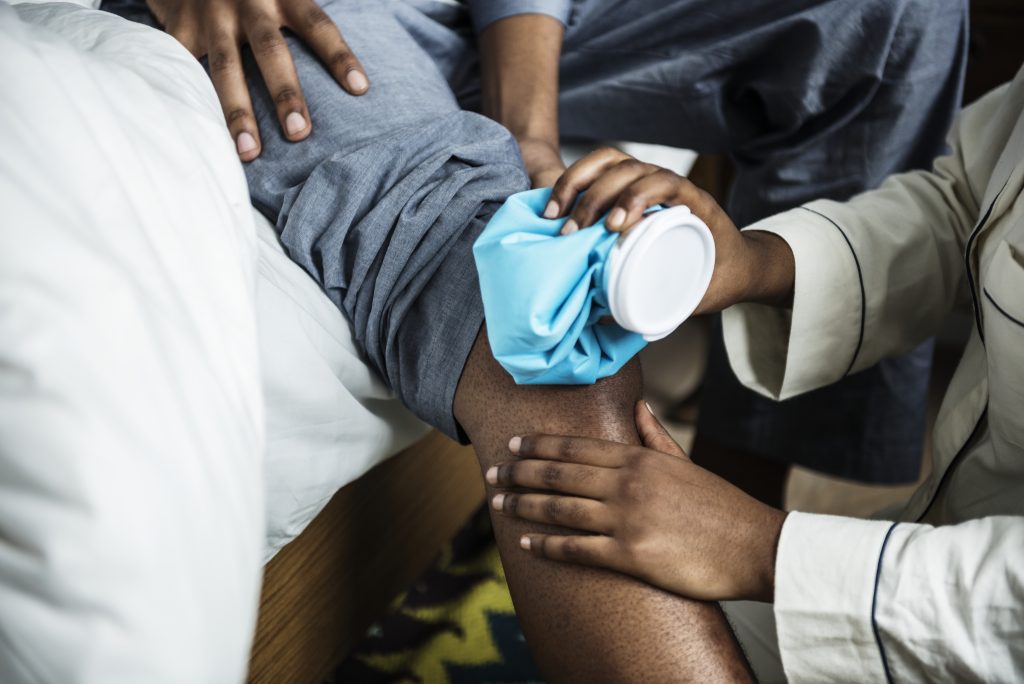
Important to know: The symptoms can vary from person to person. While some patients experience severe discomfort, others only report a slight feeling of insecurity in the knee.
If a torn cruciate ligament is suspected, the knee should definitely be examined by a doctor in order to avoid consequential damage and to initiate the correct treatment.
Cruciate ligament rupture - do I always need an operation?
The clear answer is: No, a torn cruciate ligament does not always require surgery.
Whether an operation is necessary or not depends on various individual factors. These include above all
- Age: Younger, active people are more likely to benefit from surgery.
- Activity level: People who regularly do sport or work physically often have higher demands on the stability of the knee.
- Sport: Sports with quick changes of direction (e.g. soccer or skiing) require a particularly stable knee.
- Subjective feeling of stability: If the knee feels unstable in everyday life or keeps buckling, this is a good indication for an operation.
It is therefore not only the injury itself that is decisive, but above all your personal life situation and your goals.
When is cruciate ligament surgery advisable?
In these situations, an operation can help to permanently secure the stability of the knee and reduce the risk of consequential damage.

Cruciate ligament surgery is particularly useful if:
- you are young and active in sports
- Your knee is unstable in everyday life or frequently gives way
- you want to return to high-impact sports (e.g. soccer, handball or skiing)
- concomitant injuries are present, such as meniscus damage
In these situations, an operation can help to permanently secure the stability of the knee and reduce the risk of consequential damage.
Cruciate ligament rupture without surgery - for whom is this possible?
Not every cruciate ligament rupture requires surgery. In many cases, conservative treatment can also be successful.
Treatment without surgery is particularly suitable if:
- You are less active in sports
- Your muscles are already well developed and stabilize the knee
- you do not experience any severe instability in everyday life
The focus is on targeted physiotherapy to strengthen the muscles around the knee and improve stability.
However, it is important to note:
Without surgery, there is a certain risk of consequential damage, especially if the knee remains permanently unstable. This includes, for example, meniscus injuries or cartilage damage.
Cruciate ligament surgery - procedure, risks and recovery
In cruciate ligament surgery, the torn ligament is usually replaced with an autologous transplant, whereby the procedure is usually minimally invasive (arthroscopic). The operation usually takes around 60 to 90 minutes.
Possible risks include infections, secondary bleeding, a new cruciate ligament rupture and restricted movement. Even though complications are rare, they should be taken into account when making a decision. Healing takes several months and requires patience and consistent follow-up treatment.
How long does rehabilitation take after cruciate ligament surgery?
Rehabilitation is a crucial part of treatment and has a major influence on long-term success.
It usually takes 6 to 9 months until the knee is fully resilient, sometimes even longer – especially in patients with sporting ambitions.
Rehabilitation takes place in several phases:
- Early phase: pain relief, reduction of swelling and initial movement exercises
- Build-up phase: Targeted muscle development and improvement of stability
- Return to sport: gradual increase in load and sport-specific training
Structured and consistent rehabilitation is crucial to minimize the risk of a new cruciate ligament rupture.

Decision support: surgery or not?
Rather an operation, if:
- you would like to do intensive sport again
- Your knee is unstable or frequently "bends"
- you have high stress levels in everyday life
Rather no operation if:
- you can cope well in everyday life
- you do not experience any unstable moments
- You are prepared to do physiotherapy consistently
Important: This guide is not a substitute for medical advice. An individual assessment by a specialist is crucial.
Conclusion - cruciate ligament rupture surgery - yes or no?
There is no general answer as to whether an operation is necessary or not. The right decision always depends on your personal situation, your goals and how stable your knee feels. Both surgery and conservative therapy can be successful – the key is to choose the right approach for you.
Therefore: Let me advise you individually to make the best decision for your long-term health.